European Union (EU)
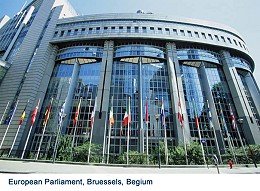
The EU Parliament is the only institution directly elected by EU citizens. The Lisbon Treaty has given more power to the Parliament. From 2014 the Parliament will have co-decision powers with the Council except in the areas of defence and foreign affairs. The EU Parliament has an increasing impact on the daily lives of the 500 million people living in the EU. Its decisions will also have a far reaching impact on lives of people living in the developing world. Decisions on trade and the environment will either enhance or further disadvantage the well being of EU citizens as well as that of citizens of developing countries.
Direct Elections to the European Parliament are held every 5 years. They take place within a 4 day period. This year the Elections take place on Friday May 23rd – 8.00am – 10.30pm
There are 766 members of the European Parliament (MEPs) elected by 28EU states, since Croatia joined the EU in 2013. Following the European Council Decision of June 28th 2013 after the 2014 Elections there will be 751 MEPs. Ireland MEP representation is reduced to 11 MEPs
For the 2014 Elections the number of EU constituencies in Ireland will be reduced from 4 to 3.
Dublin will elect 3 MEPs. The Midlands – North-West and South will each elect 4 MEPs. The North-West and East constituencies are to be abolished. a new 4 seat constituency called Midlands - North West will be created. It will comprise all the area of the current North West constituency with the exception of County Clare which is being moved to the South constituency as well as North Leinster part of the East constituency.
The South constituency will be increased in size by the addition of counties Carlow, Clare, Kilkenny, Wexford and Wicklow.
Results of The EU Elections May 2014
List of Elected MEPS June 2014
Growth of The E.U.
After Word War II in order to prevent another World War Jean Monnet and Robert Schuman approached the leader of the German people Chancellor Adenauer and shared their dream with him. He immediately saw the value of their vision and agreed to work for a peaceful and prosperous Europe. The leaders of the 4 neighbouring countries, Italy, Netherlands, Belgium and Luxembourg, quickly supported the idea of creating a new Europe, and were committed to building a peaceful and prosperous Europe. At the beginning in 1951 the European Union, known as the European Coal and Steel Community, had 6 members – France, Germany, Italy, Netherlands, Belgium and Luxembourg. Other countries, among them Ireland, asked to join and at present there are 28 countries in the E.U. and 3 more (Turkey, Former Yugoslav Republic of Macedonia) have applied for membership.
These are the current members of the E.U.
Austria, Estonia, Hungary, Luxembourg, Slovakia, Belgium, Bulgaria, Finland, Ireland, Slovenia, Cyprus, France, Italy, Malta, Spain, Czech Rep., Germany, Latvia, Netherlands, Sweden, Denmark, Greece, Lithuania, Portugal, Romania, Poland, UK, Croatia.
In 1973 Ireland, Denmark and the U.K. were the first 3 countries to join the founding countries and the remaining countries joined in the 1980s, 1990s 2004, 2007 and 2013
The Powers of the EU Parliament
The E.U. Parliament is the only institution directly elected by E.U. citizens. In recent years the Parliament has been given more power. It must be consulted by the European Council before decisions can be made.
The Parliament has power to:
- influence European laws and policies
- accept or reject EU legislation proposed by the Commission
- approve international agreements
- accept or reject the budget
- approve the admission of new members
- approve the appointments of the President of the Commission
- and members of the Commission
- dismiss the Commission.
These powers require that we have competent and good people representing us and working for the good of all European citizens. It is essential that we use our vote wisely to elect such people for they have a say in decisions and policy making that affect our lives and those of our children.
How the European Union is Governed
The 5 Main Institutions of the European Union
- The European Council:
This consists of leaders of each country and the President of the European Commission. It makes all the important European laws and policies. The European Council is obliged to consult the European Parliament about the decisions it wants to take. - The Council of Ministers:
This consists of ministers from the member states with similar responsibilities – e.g. health. They make legislation for their areas of responsibilities. However, important matters and decisions must go to the European Council. - The European Parliament:
This is the only institution directly elected by European Citizens. At present it has 732 MEPs. Until 2007 13 of them will be Irish. The members of the E.U. Parliament cannot number more than 736. With the addition of new member states to the E.U. the number of MEPs representing each state will change. The Parliament was set up to give the people of Europe a direct voice. It can question decisions and has more and more power to change or delay draft laws. The Parliament must be consulted by the European Council. - The European Commission:
At present the Commission consists of at least one representative from each member country. It ensures that European laws and policies are carried out. The Commission also proposes new laws and policies to the European Council and Parliament. The Commission has little decision making power although it has considerable influence. The number of commissioners will change with the number of countries joining the E.U. - The European Court of Justice:
This consists of one judge from each member state. It is responsible for enforcing European law.EP 2014
European Elections: less means more
The European Parliament will slim down from 766 MEPs this summer to 751 after the 2014 elections, but how to decide which countires should give up a seat? MEPs decided to opt for the fairest and most equitable solution when they adopted a proposal on it on Wednesday March 13th.
- EAPN Ireland Review Special Review April Mary 2014 - information on Elections
- click on this link for -How the EU works
- click on this link for - Ireland in the EU
For more information visit websites
- http://ec.europa.eu/ireland
- http://www.europarl.europa.eu
- Report on European Parliament Constituencies 2013
Local and EU Elections - May 24th 2019
EU Elections The following are links to the material from the European Parliament office Dublin
Brochures e.g. European Elections – this time im voting E.U.
What is the European Parliament
Good Reason to Vote in the European Elections 2019
Voting Eligibility Across the EU
www.thistimeimvoting.eu – “In advance of the European elections, the European Parliament has launched an information awareness campaign called 'This Time I'm Voting'. As an apolitical campaign, our objective is to raise awareness about the elections at a local and encourage as many individuals, groups and organisations to promote the campaign within their local areas through their own individual activities.”
www.what-europe-does-for-me.eu – “To complement our election activities, the Parliament has produced a website which provides a breakdown of EU activities according to specify policy areas, subjects and regions. In Ireland, there is a county-by-county breakdown of the means by which the European Union has supported activities in the local area. The website features over 8,000 fiches and provides in-depth information on different benefits of EU membership.”
www.european-elections.eu – “Lastly, the EU has produced a concise website which provides information about how to vote in different countries throughout the EU. As such, it provides information about how EU nationalities can vote in the European elections here in Ireland.”
The Identify of the EU candidates.
EU Elections – you are probably aware that Ireland has 11 MEP’s - 3 Representing Dublin, 4 Representing Ireland South and 4 Representing Ireland Midlands and North West
The Returning Officers for the three European constituencies: Dublin, South and Midland-North-West have officially announced the candidates running for the European elections. You may find a list of all candidates here:
(i) Dublin - https://dublincountyreturningofficer.com/index.php/euro-local-elections-2019/65-notice-
of-poll-euro-2019
(ii) South - https://corkcityreturningofficer.com/
(iii) Midlands-North-West - https://www.mayoreturningofficer.com/nominations
In total, there are 59 candidates contesting the European elections across all 3 constituencies.
“Should you wish to reach out them in any capacity, a public website has been created a group of citizens with contact information for the local and European election candidate. You may find it here: www.candidates.ie. Please note that the EU Parliament Office does not endorse any website.”
The position regarding the number of MEPs. The possible increase in the number of Irish MEPs because of Brexit.
The Minister for Housing Planning and Local Government, Eoghan Murphy, confirmed that Ireland will elect 13 MEPs in the upcoming European elections. The breakdown of those seats is as follows:
Dublin – 4 MEPs (including 1 additional seat due to the reallocation of seats arising from Brexit) South – 5 MEPs (including 1 additional seat due to the reallocation of seats arising from Brexit) Midlands-North-West – 4 MEPs
“In the event that the United Kingdom is still a member of the European Union by the start of the new Parliament term (which commences on the 1st July 2019), the additional two seats that have been allocated to Ireland will be placed on hold until Britain officially leaves. As such, the candidates who win the 4th seat in Dublin and the 5th seat in Ireland South respectively will only take up their seats once Brexit occurs.”
European Elections Manifesto 2019
Coalition 2030 Election Manifesto